IX Mercado Cultural da Bahia, Teatro Castro Alves, Salvador
The meeting place for Brazil and other cultures, the international arena that brings our world together, is the annual Mercado Cultural da Bahia. This is a great cultural exhibition combining festival performances and concerts, a real cultural marketplace that presents the best of music and dance without extensive conference sessions and discussion groups. The emphasis is on the performance media that are the direct expression of the lifeblood of cultural expression. It celebrates multicultural Brazil.
This year was the IX Mercado Cultural da Bahia, now an established tradition of its own, that was held November 26 through December 12 in Salvador, Bahia, and in six other cities. Bahia is one of Brazil’s twenty-six states, located in the northeastern part of the country on the Atlantic coast. Its cultural heritage has always flourished, and is reflected in the famous musicians from that region, Caetano Veloso and Gilberto Gil, among others.
Baião, a rhythm typical to this region, is heard everywhere one travels, in the street, in parks, in restaurants. It is literally everywhere! Although not very well known outside Brazil, it has enormous influence over much of modern Brazilian music. The traditional instrumental baião is a musical form based on an ancient figure dance or ballroom dance of European origin. In the Northeast region of Brazil this form was played by local bands that performed in salons and in private parties and at various religious and social celebrations.
The theme of this year’s celebration was “passage,” the engagement of people and artistic expression. “With the theme …Passage…, the IX Mercado Cultural follows paths towards Bahia’s country, enabling and strengthening the interchange between global cultural production and local cultural movements.” The Project Mission agenda identified the interchange and the experiences among communities, be it on an international, national or regional level. This year’s celebration was an all-out effort for community outreach on all levels, and the expansion of the youth and children’s audience.
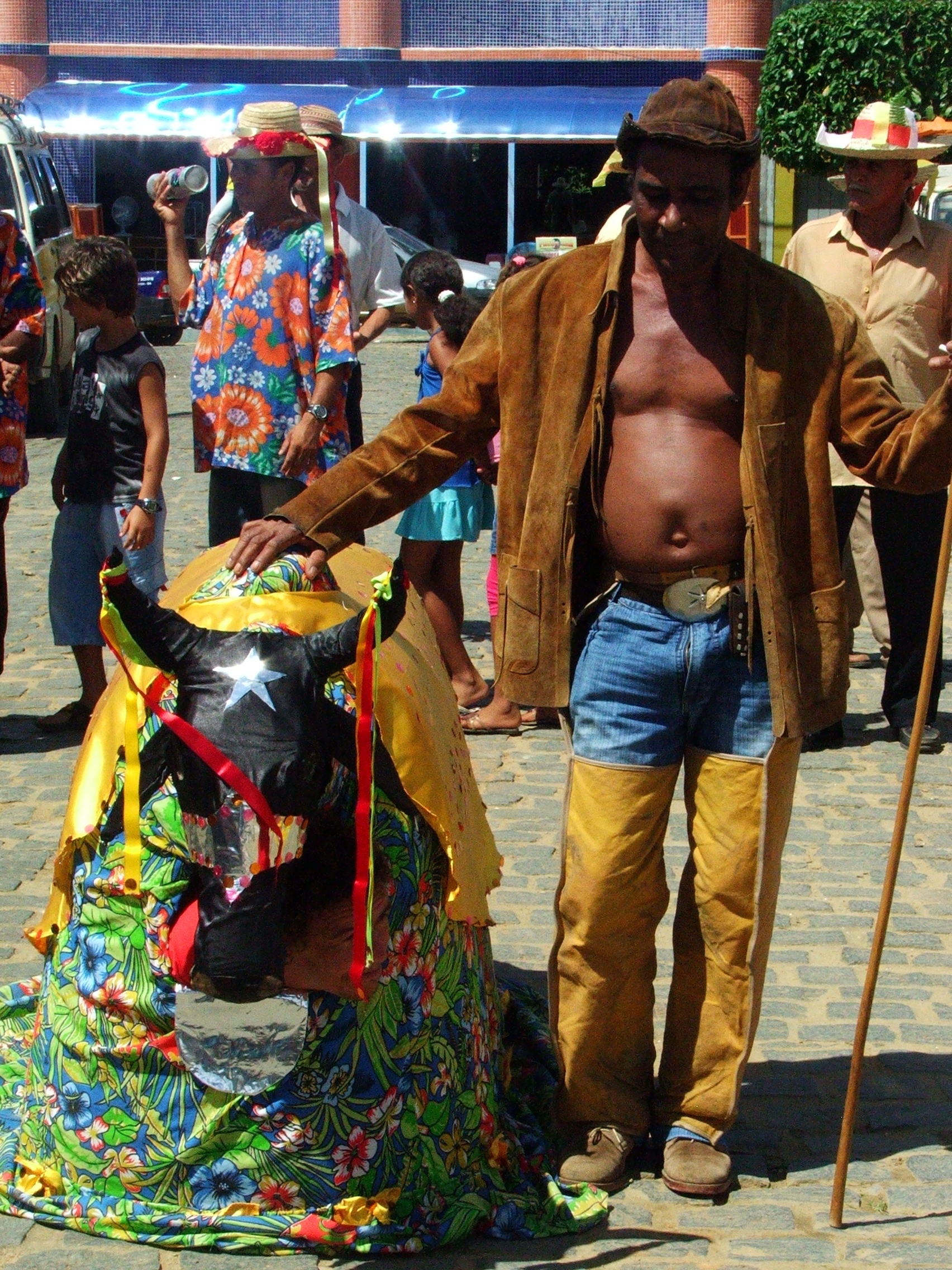
Boi de Dona Laurinha
There was a broad range of participants in this year’s festival. Individual artists, cultural music groups, world music groups as well as dance and theater troupes came together in the spirit of international sharing and learning. From Brazil there were the vocal and instrumental groups, A Barca, Bongar, Retrofoguetes, and Trio Arguida, and among the individual vocalists, Mariene de Castro and Maciel Salu. Representing the global music scene were Alo Lrmao of Galicia, Spain, Juan Pablo Villa e Arturo Lopez of Mexico, Mariana Baraj of Argentina, and The Idan Raichel Project of Israel. There were two groups representing South Korea, the percussion ensemble, Sonagi Project, and the Chae Soo-Jung Performance Company, that presented pansori and shaman ritual performance.
In an interview with Benjamin Taubkin, composer and Director of IX Mercado Cultural da Bahia, he offered some keen observations and we had a lively exchange. He believes that the Mercado Cultural is in transition, and that each “cultural market” around the world has its own essential characteristics but music is the most important above all the others. The Mercado Cultural is a meeting place for artists to exchange ideas, and the Bahia Market is one of the finest in the world. In the past, the Mercado was 90% Brazilian art and 10% international, but this year the mix was 50/50. In this way the character of the Mercado Cultural has broaden to include much more of the global market, and the local community meets more global artists.
Taubkin strongly asserts that tradition is the key element but he believes that tradition should not become the spider web in the corner—something that traps culture in the past. Tradition should—and can—still communicate with the modern audience. We both agreed that world music is in a crisis situation today, heavily influenced by commercialism and promoted as a commodity. Because of the strong economic control, much of the distinctiveness of individual musics is compromised, and the labels of “world beat,” “global,” “pop,” among others, tend to blur the fine points of style and culture. Broadcasting and recording media are powerful forces that control the music industry around the world, including the musicians themselves. He believes that music should be audience-oriented and not commodity-oriented. All of these observations taken together, he believes, contribute to cultural weakness.
He was highly critical of the Idan Raichel Project of Israel, one of Israel’s most popular music groups, that has been an influential force in the changing the face of Israeli popular music, offering a message of love and tolerance. The group offers a blend of African, Latin American, Caribbean and Middle Eastern maqam musical styles, combining the forces of Israeli refugee musicians from Ethiopia, Columbia, and Afghanistan. But instead of the meeting the potential of such a fusion and combination of musical styles, what was presented was more like club music heard in major cities around the world. It was commercialized music and a rock band commodity that had musicians who might have come from any number of places around the world. The uniqueness of this particular group was lost in the superficial pop style and according to Mr. Benjamin Taubkin, this was a cultural insult, with the inference that Brazilians like only popular club-style dancing.
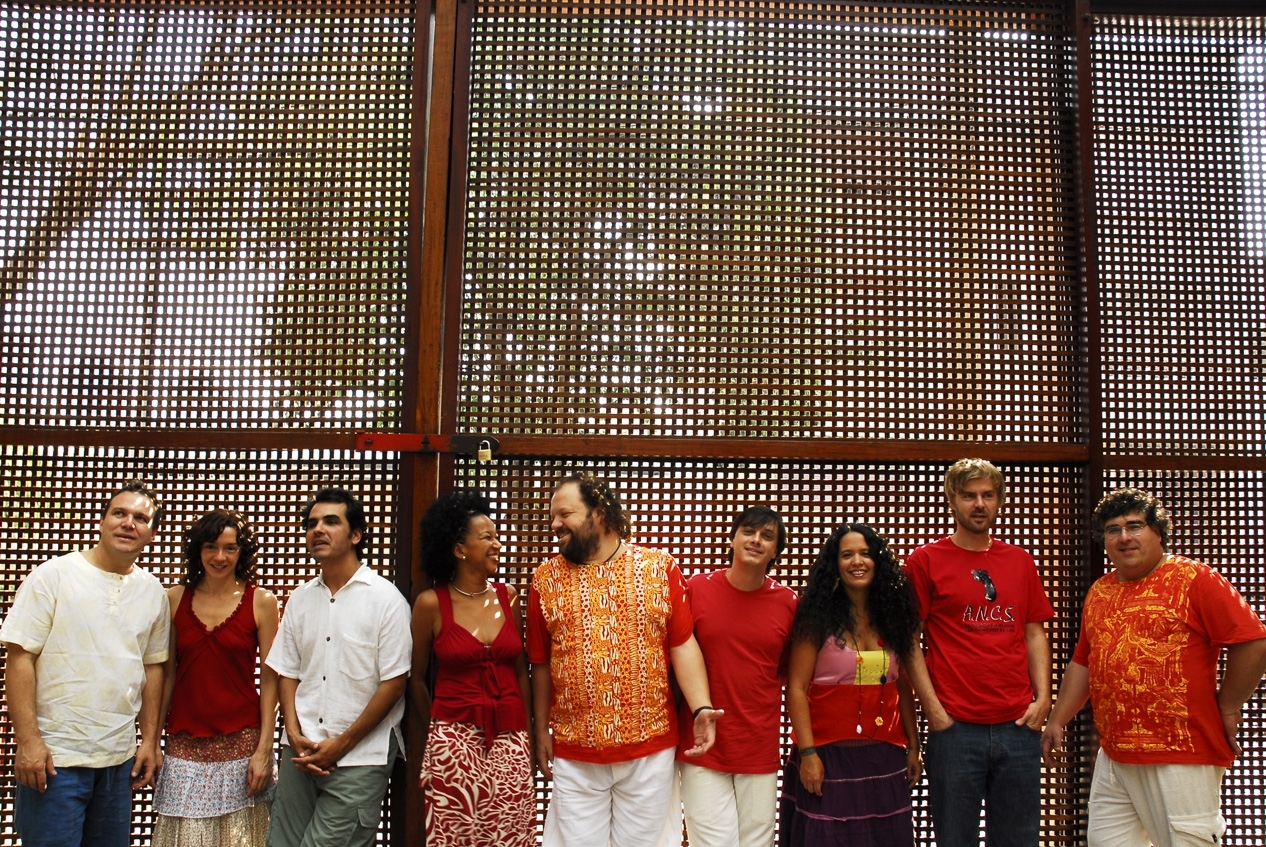
A Barca
As a sharp contrast in this year’s Mercado Cultural, A Barca is popular music group from Sao Paulo which works with research and the movement of Brazilian popular culture. They perform a broad range of creative works that based on documentation and education through art and cultural production. These musicians reflect on the indigenous cultural production and its aesthetic. They have bonded with, and are socially responsive to, the many under privileged communities in Brazil. One example was a work based on an old man’s song, a song that may soon disappear from the face of the traditional world in Brazil that was presented with a video clip of that man singing. It was a unique and meaningful combination that reflects their own statement, “[B]elieving traditional culture as essential material to the development of the Brazilian artist as raw material for a universal artistic creation, A Barca intends to reflect comprehensively over art’s role within a traditional community.”
By happy coincidence, while we were at the Mercado Cultural, the group’s leader, Lincoln Antonio, a pianist, took us to a cultural event at Casa Blanca in Salvador. It was one of the shaman rituals of Candomble, the Oxum festival for the god of water. Antonio led all the visiting Koreans to this event to give us the opportunity to see and hear the way he and A Barca work. They find musical materials in such traditional events, and bring them into a modern performance arena. They unite the traditional with the modern, a point of view held equally strongly by this writer.
Among the visiting Korean groups, the Sonagi Project is a Korean percussion group that performs various rhythmic traditions on five janggo. The Korean rhythms speak to Brazilians listeners because Brazilian rhythms and improvisation are very close cousins in the global music world. In particular, Jae Hyo Jang, the leader of the ensemble, challenges the rhythmic traditions long established in Korean culture. For example, rhythms from samulnori, usually performed on four different percussion instruments, are played by the five janggo of this group. They explore the drum’s timbres and expressive power, basing their interpretation on the old tradition but with a new, modern twist the offers a unique perspective and listening opportunity. This is a perfect example of the spider’s web being extended, the old being made new.
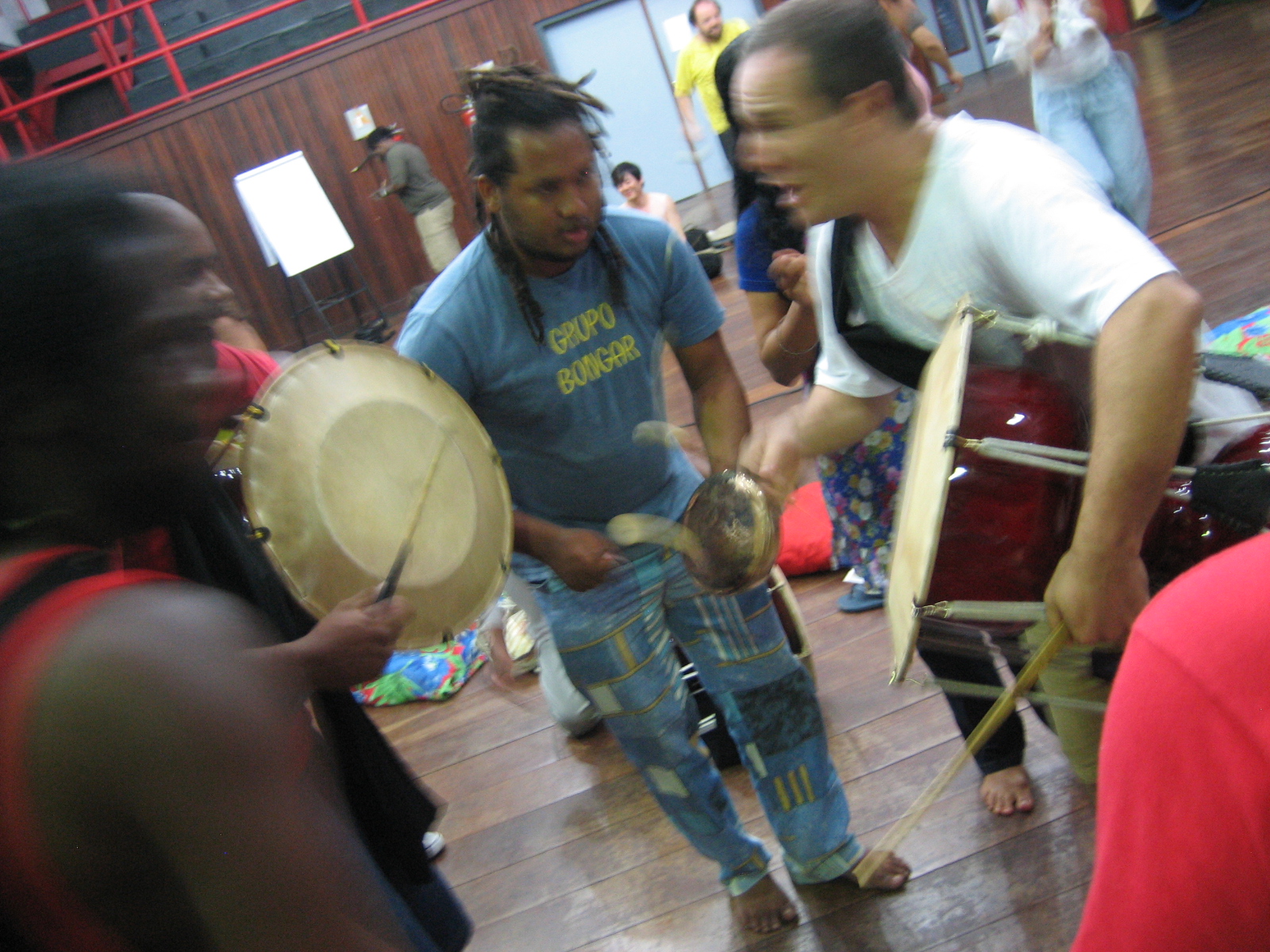
Brazilian music group BONGAR and A BARCA in Sonagi Project's workshop
The other Korean group was Chae Soo Jung, that presented pansori and the shaman ritual for the dead, ssitgimgut. Even though the cultural context for this music was absent during Mercado Cultural, there was an immediate and powerful understanding of the energy and passion that this music conveys. Brazilians responded to the deeply human drama of life and death through the great musical expressive elegance that is uniquely Korean.
Music traditions are some of humankind’s most complex creations. Tradition has the strenuous task of making a place for itself on the modern stage, competing for audience attention and performers’ sensitivity and skill. But tradition offers a very special encounter with the human soul. The distance collapses when the music begins. The old and the modern meet each other face-to-face, and they know that they are very much the same. Humans around the world do understand what it means to be alive, to be expressive, and to be energized by great musical traditions. The Mercado Cultural da Bahia is a perfect example of how this might happen and how we all might be enriched. Perhaps Taubkin is right, that the cultural marketplace is in transition, and that tradition itself is an ever evolving phenomenon.
Ju-Yong Ha, born in Seoul, South Korea,
is a prolific composer whose compositions have been performed in concerts to critical acclaim and enthusiastic acceptance in Seoul, New York, Boston, San Francisco, Santa Fe, New Mexico, and Hartford, Connecticut, where his music won the New World Chamber Ensemble composition competition sponsored by the Hartford Symphony Orchestra. Mr. Ha is also dedicated to scholarly work in music theory, especially the music of Mozart and Strauss, and in ethnomusicology, specializing in Korean music, and has been invited to present his work at international conferences including SEM and CMS. Ju-Yong Ha has received his doctoral degree from the Graduate Center of the City University of New York, and has completed his dissertation on the modal system of Korean traditional folk genres, and composing a large orchestral composition. For the last five years he has taught music as an adjunct professor at City College of New York and New York College of Technology, and most recently, he has been a faculty member of the music Department of Baruch College in New York.