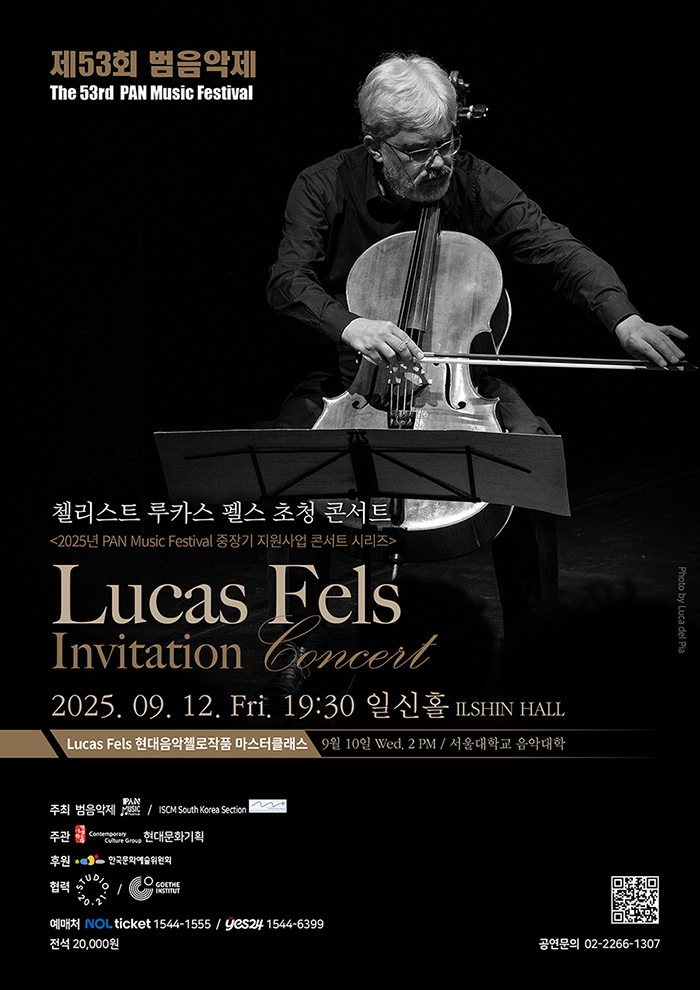
<2025년 Pan Music Festival 중장기 지원사업 콘서트 시리즈> 53rd Pan Music Festival 제53회 범음악제 Lucas Fels Invitation Concert 첼리스트 루카스 펠스 초청 콘서트 2025. 9. 12 / 금 / 7:30 pm 일신홀 Lucas Fels 현대음악첼로작품 마스터클래스 2025. 9.10.(목) 2:00pm / 서울대학교 음악대학 주최 _ 범음악제 / ISCM South Kea Section 주관 _ 현대문화기획 후원 _ 한국문화예술위원회 협력 _ STUDIO 2021, GOETHE INSTITUT 예매처 _ NOL티켓 1544-1555 예스24공연 1544-6399 공연문의 _ 02 2266 1307 전석 20,000원 [프로필] Lucas Fels (Cello, Arditti Quartet) 독일 Lörrach에서 태어난 루카스 펠스는 바젤과 취리히에서 첼로를 처음 배웠고, 프라이부르크에서는 크리스토프 헨켈에게, 암스테르담에서는 안너 비일스마에게, 피에솔레에서는 아마데오 발도비노에게 사사했다. 명망 높은 앙상블 Recherche의 창립 멤버로서 루카스 펠스는 오랫동안 현대실내악 및 앙상블 음악 발전에 적극적으로 참여해 왔으며, 21년간 앙상블 멤버로 활동하면서 수백 곡의 작품을 초연했다. 2006년에는 아르디티 콰르텟에 합류하여 전 세계에서 수많은 작품을 초연했다. 아르디티 콰르텟과 함께한 음반에는 H. 라헨만, P. 뒤사팽, J. 하비, H. 버트위슬, R. 게르하르트, B. 페르니호, B. 카사블랑카스의 현악 사중주 전곡이 포함되어 있다. 또한 그는 Wolfgang Rihm(Styx und Lethe, 1998), Walter Zimmermann(Subrisio Saltat, 2003), Sebastian Claren(After By Palermo 2002), Mathias Spahlinger(Lamento, protokoll 2013) 등의 첼로 협주곡을 초연했다. 루카스 펠스는 여러 음악원에서 정규적으로 가르쳤고 Darmstädter Ferienkurse에서 20년 넘게 강의한 선생으로서 매우 인기가 높다. 2013년부터 그는 프랑크푸르트 국립음대에서 "Interpretatische Praxis und Vermittlung neue Musik" 교수로 재직하고 있다. [프로그램] Enno Poppe <Zwölf> Younghi Pagh Paan <아가(雅歌)1> (AA-GA I) Brian Ferneyhough <In Nomine> Intermission Brice Pau <aus: Rasch> Mark ré <E> Jonathan Harvey <Curve with Plateau> 조윤제 <소멸 (Dissolution)> [작곡가 프로필 및 작품해설] Enno Poppe (*1969) 1969년 자우어란트(Sauerl) 헤머(Hemer)에서 태어난 엔노 포페는 독일 New Music에서 가장 중요한 젊은 작곡가 중 한 명이다. 그는 베를린국립음대(Universität der Künste Berlin)에서 Friedrich Goldmann에게 지휘를, Gösta Neuwirth에게 작곡을 배웠다. 그 후 베를린공대(Technische Hochschule Berlin)과 칼스루헤(Karlsruhe)의 예술 및 미디어센터(Zentrum für Kunst und Medientechnologie)에서 사운드합성과 알고리즘작곡 공부를 했다. 엔노 포페는 Akademie Schloss Solitude와 the Villa Serpentara in Olevano Romano로부터 장학금을 받았고 1998년 보리스 블라허 상, 2000년 슈투트가르트시 작곡상, 2002년 베를린예술아카데미의 부조니 작곡상, 2004년 에른스트 폰 지멘스 음악재단 후원상, 2005년 슈나이더 쇼트 상, 2009년 카스케 재단 상, 2011년 한스 앤 게트루트 첸더 재단 상, 2013년 한스 베르너 헨체 상을 수상했다. 베를린 한스아이슬러 국립음대에서 2년간 가르친 후, 엔노 포페는 2004년부터 2010년 사이에 다름슈타트 New Music 여름강좌와 오스트리아 그라츠의 Impuls 아카데미 작곡세미나에서 여러 차례 가르쳤다. 그는 1998년부터 베를린 앙상블 mosaik의 지휘자로 활동하고 있으며 Klangfum Wien, musikFabrik 등 다양한 앙상블과 함께 유럽 전역에서 연주하고 있다. 그는 여러 음악제로부터 작품위촉을 받아오고 있으며 그의 작품은 뮌헨 Ricdi에서 출판되었으며 수많은 CD 음반을 발매했다. Enno Poppe, bn 1969 in Hemer/Sauerl, is one of the most imptant younger composers of New Music in Germany. He studied conducting composition at the Berlin University of the Arts, among others with Friedrich Goldmann Gösta Neuwirth. This was followed by further studies in the fields of sound synthesis algithmic composition at the Technische Hochschule Berlin the Zentrum für Kunst und Medientechnologie in Karlsruhe. In addition to scholarships - including from the Akademie Schloss Solitude the Villa Serpentara in Olevano Romano - he received the Bis Blacher Prize in 1998, the Composition Prize of the City of Stuttgart in 2000, the Busoni Composition Prize of the Akademie der Künste Berlin in 2002, the Sponsship Prize of the Ernst von Siemens Music Foundation in 2004, the Schneider Schott Prize in 2005, the Kaske Foundation Prize in 2009, the Hans Getrud Zender Foundation Prize in 2011 the Hans Werner Henze Prize in 2013. After teaching f two years at the Hanns Eisler Academy of Music in Berlin, Enno Poppe taught several times between 2004 2010 at the Darmstadt Summer Courses f New Music the composition seminars of the Impuls Academy Graz/Austria. He has been conduct of the Berlin ensemble mosaik since 1998 perfms throughout Europe with various ensembles such as Klangfum Wien musikFabrik. He has received commissions from many music festivals his wks are published by Ricdi Munich have appeared in numerous recdings on CD. <Zwölf (12)> (2014) 엔노 포페는 숫자 12가 "신화적인 숫자"라고 말한다. 그는 12음 기법의 성공이 주로 12개의 동일한 간격으로 나뉜 옥타브의 신화적인 힘과 관련되어 있다는 이론을 제시한다. 포페가 참고한 것은 피에르 불레즈의 <Messagesquisse>이지만 1940년대 중반에 작곡된 불레즈의 <피아노를 위한 12개의 Notations>도 일정 부분 영향을 주었다. "저는 확실히 하나의 스타일을 사용하고 싶지 않았습니다. 당시 작곡가들이 어떻게 모든 것을 12라는 숫자와 관련하여 검토하고 수정하려는 아이디어를 생각해 낼 수 있었는지에 관심이 있었습니다." <12>는 포페의 <바이올린을 위한 17개의 연습곡> 2권과도 유사점이 있다. 이 초기 작품이 두 음표 모티프에서 무려 289개의 변주곡을 추출(그리고 압축)하는 반면, <12>는 12개의 미니어처로 표현한다. "이 미니어처들은 빠른 속도로 연이어 등장하는데 첫 번째 미니어처는 3초밖에 되지 않지만, 실제로는 모든 소재를 담고 있습니다. 이후의 미니어처는 항상 이전 미니어처보다 조금 더 길어집니다. 즉, 같은 소재가 각기 다른 지점에서 다르게 팽창하여 새로운 싹을 틔웁니다. 이러한 과정은 실제로 성장 과정이지만, 항상 짧게 끝납니다. 기본적으로 이러한 장소들을 사진으로 찍는 것과 같습니다. 이전과 이후의 순간은 항상 누락되어 있습니다. 심지어 마지막 조각조차도 너무 짧아서 마치 한 과정의 열두 장의 이미지를 보는 것처럼, 마치 사진 앨범을 보는 것처럼 하나의 단위로 인식될 수 있습니다." - Rainer Pöllmann The number twelve is a “mythological number,” says Enno Poppe. He ventures the they that the success of twelve-tone technique is primarily ed to this mythical charge of the octave divided into twelve equal intervals. Poppe's point of reference was Messagesquisse by Pierre Boulez, but of course, in connection with serial thinking in s of 12, the twelve Notations f piano, composed in the mid-1940s, also play a certain role. "I definitely didn't want to use a style. I was interested in the question of how composers at that time could have come up with the idea of examining fixing everything in relation to the number twelve.” However, there is also a parallel to Poppe’s 17 Etudes f Violin, Book 2. Both wks are about four minutes long. While that early wk extracts ( compresses) no less than 289 variations from a two-note motif, Poppe limits himself in Twelve to just twelve miniatures, which, however, also follow each other in rapid succession. "The first miniature is only three seconds long, but actually contains all the material. Each subsequent miniature is always a little longer than the previous one, i.e. the same material exps differently at different points, thus generating new shoots. These processes are actually growth processes, but they are always cut sht. Basically, it's like taking photographs of these places. The moment befe after is always missing. Even the last piece is so sht that it can be perceived as a single unit, as if you were looking at twelve images of a process – as if you were looking through a photo album." - Rainer Pöllmann Younghi Pagh Paan (*1945) 박영희(1945년 청주 출생)는 가장 중요한 현대음악 여성 작곡가 중 한 명이다. 그녀는 도나우에싱겐 음악제(1980)에서 오케스트라 작품 위촉을 받은 최초의 여성이었고, 독일 브레멘 대학교(1994)에서 작곡과 교수로 임명된 최초의 여성이었다. 작곡가이자 교육자로서 그녀는 여러 세대의 작곡가들에게 영향을 미쳤다. 그녀는 1965년부터 1971년까지 서울대학교에서 공부한 후 1974년 DAAD 장학금을 받아 독일로 갔다. 그녀는 프라이부르크 국립음대에서 Klaus Huber(작곡), Brian Ferneyhough(분석), Peter Förtig(음악 이론), Edith Picht-Axenfeld(피아노)를 사사했고 1979년에 졸업했다. 자아와 타자 사이의 갈등은 그녀의 예술적 사고에 큰 영향을 미쳤다. 그녀의 많은 작품이 한국 제목을 가지고 있으며 이 두 극단 사이의 균형을 모색한다. 그녀의 작품에서 또 다른 중요한 주요 내용은 도피, 이주, 무국적, 폭력 및 저항과 같은 정치적 주제에 대한 집착이다. 1980/81년에 그녀는 남서독일라디오의 하인리히 슈트로벨 재단에서, 1985년에는 바덴뷔르템베르크 예술 재단에서 기금을 받았으며 하이델베르크 여성 예술가상(1995), 서울대학교 평생공로상(2006), 대한민국 국민훈장(2007), 제15회 KBS 글로벌 한국인상(2009), 브레멘 시에서 수여하는 상원 예술과학 훈장(2011), 백남상(서울, 2013), 유럽교회 음악상, 그리고 2020년에는 2009년부터 회원으로 활동하고 있는 베를린 예술 아카데미에서 최고 예술상을 수상했다. 그라츠(1991)와 카를스루에(1992/93) 음악원에서 객원교수로 재직한 후, 박영희 는 1994년 브레멘 예술대학교(Bremen Hochschule für Künste)에서 작곡교수로 임명되었다. 그녀는 그곳에서 뉴 뮤직 아틀리에를 설립하고 2011년 은퇴했다. Younghi Pagh-Paan (*1945 Cheongju, South Kea) is one of the most imptant women composers of her generation. She was the first to receive an chestral commission f the Donaueschingen Festival (1980) the first to be appointed profess of composition at a German university (Bremen, 1994). Both as a composer teacher, she has influenced several generations of composers. Pagh-Paan studied from 1965 to 1971 at Seoul National University befe a DAAD Scholarship took her to Germany in 1974. There she continued her studies at the Freiburg Hochschule für Musik with Klaus Huber (composition), Brian Ferneyhough (analysis), Peter Förtig (music they) Edith Picht-Axenfeld (piano), graduating in 1979. The conflict between Self Other strongly influenced her artistic thinking; many of her wks bear Kean titles seek a balance between these two poles. Another imptant mainstay of her output is a preoccupation with political subjects such as flight, displacement, statelessness, violence resistance. In 1980/81 she had a fellowship from Southwest German Radio’s Heinrich Strobel Foundation in 1985 from the Baden-Württemberg Art Foundation. She has received numerous international prizes f her wk: the Heidelberg Prize of Women Artists (1995), the Lifetime Achievement Award of Seoul National University (2006), the Republic of Kea’s der of Civil Merit (2007), the 15th KBS Global Kean Award (2009), the Senate’s Medal f Art Science from the city of Bremen (2011), the Paiknam Prize (Seoul, 2013), the European Church Music Prize , in 2020, the Gr Art Prize from the Academy of Arts in Berlin, of which she has been a member since 2009. Following guest professships at the music conservaties of Graz (1991) Karlsruhe (1992/93), Younghi Pagh-Paan was appointed profess of composition at the Bremen Hochschule für Künste (University of the Arts) in 1994. There she founded the New Music Atelier taught until her retirement in 2011. <아가(雅歌)1 (AA-GA I)> für Violoncello solo (1984) "한문 두 자로 표현되는 <아가(雅歌)>는 직역이 어렵지만 '노래로 올리는 칭송'의 뜻을 담고 있다. 나는 이 '아가'라는 주제로 여러 개의 독주곡을 작곡할 계획이며 그 첫 번째 곡으로 바이올린 첼로를 택했다. 첼로는 그 깊은 음색 때문에 내게 친밀감을 주는 악기로 어떤 감정의 분출을 표현한다 해도 가볍게 들리지 않는 것이 그 특징이다. <아가>는 진리를 위해서 자신의 희생이 불가피하다고 생각하면, 기꺼이 죽음까지도 택한 분들에게 헌정하는 곡이다. 첼로를 위한 이 곡의 형식적인 흐름은 한국의 현대시인 천상병의 짧은 시에서 따온 것이다." <천상병의 편지> 아침 햇빛보다 더 맑았고 全世界보다 더 복잡했고 어둠보다 더 괴로웠던 사나이들, 그들은 이미 가고 없다. "나는 이 시의 비유적인 착상들을 선율로 옮겨보고자 했다. 악상으로는 서로 상반되는 두 개의 요소를 설정하고 그 이율배반성의 표출을 세번에 걸처 변형하여 표현하였다. 이렇게 지속적인 변형의 과정을 악상으로 옮겨놓은 의도는 두 요소에 내재하는 대립성을 드러내기 위해서이다. 이 두 요소의 변형 사이에는 나타났다 사라졌다 하는 아주 투명한 음색의 제 3 요소가 있다(피치카토). 이 제 3 요소는 곡 말기에 이르러 가장 선명하게 그 모습을 들어내어 곡 전체를 평정한다. 나는 암울한 역사 속에서 빛이 되고자 했던 이들이 잊혀져서는 안된다는 생각에서 이 곡을 썼다." "The wd <AGA>, expressed in two Chinese characters <雅歌>, is difficult to directly translate, but it carries the meaning of 'praise through song.' I plan to compose several solo pieces with this theme of <AGA>, I chose the violin cello f the first piece. The cello is an instrument that feels close to me because of its deep tone, its characteristic is that no matter what emotional outburst it expresses, it does not sound light. <AGA> is a piece dedicated to those who willingly chose even death if they felt that their sacrifice f the truth was inevitable. The fmal flow of this piece f cello is taken from a sht poem by the modern Kean poet Cheon Sang-byeong." <Cheon Sang-byeong's letter> Men who were clearer than the mning sun, me complex than the entire wld, me tmented than darkness— they are already gone. "I attempted to translate the phical ideas of this poem into melody. The musical notation established two opposing elements expressed their contradiction through three transfmations. The intention behind this continuous process of transfmation in musical notation was to reveal the inherent opposition between the two elements. Between the transfmations of these two elements, there is a third element (pizzicato), a very transparent tone that appears disappears. This third element reveals itself most clearly toward the end of the piece, calming the entire piece. I wrote this piece with the belief that those who sought to be a light in the midst of a dark histy should not be fgotten." Brian Ferneyhough (*1943) 브라이언 퍼니호는 오늘날 가장 뛰어난 현존 작곡가 중 한 명으로 널리 인정받고 있다. 1970년대 중반, 처음으로 국제적인 명성을 얻은 이후, 그의 음악은 현대 음악계에서 가장 영향력 있는 창작자이자 중요한 음악 사상가 중 한 명으로 명성을 쌓아왔다. 퍼니호는 1943년 영국 코번트리에서 태어나 버밍엄 음악학교와 런던 왕립음악원에서 정식 음악교육을 받았다. 1968년에는 멘델스존 장학금을 받아 암스테르담에서 톤 드 레우에게 사사했고, 이듬해에는 바젤 음악원에서 클라우스 후버를 사사할 장학금을 받았다. 유럽 본토로 이주한 후, 퍼니호의 음악은 더 폭넓은 인정을 받기 시작했다. 네덜란드 가우데아무스 작곡콩쿠르에서 현악사중주 소나타, 에피사이클, 미사 브레비스로 3년 연속(1968-70) 상을 수상했다. ISCM 이탈리아지부는 1972년 콩쿠르에서 퍼니호에게 파이어사이클 베타로 2위(우수상)를, 2년 후에는 모든 부문에서 최고의 작품으로 평가받은 타임 앤 모션 스터디 III로 특별상을 수여했다. 최근 작품으로는 Inconjunctions(2014), Contraccolpi(2016)가 있으며, Christopher Tye의 영향을 받은 작품들을 모은 Umbrations(2001-2017)도 있는데, 이 작품들은 Arditti Quartet과 Ensemble Modern이 Wittener Tage für Neue Kammermusik에서 초연했다. 또한 1984년부터 1996년까지 격년으로 개최되는 다름슈타트 페스티벌의 작곡과정 코디네이터로 활동하며 명망 높은 교육 기관들과 교류했다. 1984년에는 예술문학 기사 훈장(Chier de l'dre des Arts et des Lettres)을 수여받았으며, 이후 베를린 예술 아카데미(Akademie der Künste), 바이에른 미술 아카데미(Bavarian Academy of Fine Arts), 왕립 음악 아카데미(Royal Academy of Music)의 회원으로 활동했다. 2000년에는 스탠퍼드 대학교(Stanfd University)의 교수로 임명되었고, 2007년에는 에른스트 폰 지멘스(Ernst von Siemens) 음악상을 수상했다. Brian Ferneyhough is widely recognized as one of today's femost living composers. Since the mid-1970s, when he first gained widespread international recognition, his music has earned him an enviable reputation as one of the most influential creative personalities significant musical thinkers on the contempary scene. Ferneyhough was bn in Coventry, Engl, in 1943 received fmal musical training at the Birmingham School of Music the Royal Academy of Music, London. In 1968 he was awarded the Mendelssohn Scholarship, which enabled him to continue his studies in Amsterdam with Ton de Leeuw, the following year obtained a scholarship to study with Klaus Huber at the l Conservatoire. Following Ferneyhough’s move to mainl Europe, his music began to receive much wider recognition. The Gaudeamus Composers’ Competition in the Netherls awarded Ferneyhough prizes in three successive years (1968-70) f his Sonatas f Quartet, Epicycle Missa Brevis respectively. The Italian section of the ISCM at its 1972 competition gave Ferneyhough an honourable mention (second place) f Firecycle Beta two years later a special prize f Time Motion Study III which was considered the best wk submitted in all categies. Recent wks have included Inconjunctions (2014), Contraccolpi (2016), a collection of encounters influenced by Christopher Tye, Umbrations (2001-2017), premiered by the Arditti Quartet Ensemble Modern at Wittener Tage für Neue Kammermusik. Associated with the most prestigious teaching institutions international summer schools f contempary music, from 1984 to 1996 Ferneyhough was Composition Course Co-dinat at the biennial Darmstädter Ferienkurse für Neue Musik. In 1984 he was made Chier de l'dre des Arts et des Lettres he has since been named a member of the Berlin Akademie der Künste, the Bayrische Akademie der Schönen Künste a Fellow of the Royal Academy of Music. He was appointed William H. Bonsall Profess of Music at Stanfd University in 2000 was awarded the 2007 Ernst von Siemens Music Prize. <In Nomine> (2017) Brice Pau (*1965) 브리스 포제는 프랑스 브장송에서 태어나 피아노, 바이올린, 하프시코드를 배우며 음악 교육을 시작했고, 이후 작곡으로 전향했다. 1994년 마르셀 블루스탱-블랑셰 재단의 장학금을 받고 이르캄(Ircam)에서 수학했다. 파리에서 미셸 필리포, 제라르 그리제, 알랭 방카르를 사사한 후, 작곡가 겸 연주자로서 두 가지 경력을 쌓았으며, 하프시코드와 피아노포르테로 초기 레퍼토리를 연주하고, 때로는 현대 피아노도 연주하기도 했다. 브리스 포제는 이르캄(Ircam), 벨기에의 아르스 무지카 페스티벌 등 여러 음악제에서 많은 앙상블과 협업해 왔다. 그의 작품에는 현대음악에서 예상치 못한 음악가들의 참여가 필요한데, 예를 들어 카운터테너 제라르 레스네(Gérard Lesne)가 불렀던 '바니테스(Vanités)', 슈베르트 소나타 작품번호 10번을 기반으로 한 '콘트라-소나테(Kontra-Sonate)' 등이 있다. 슈베르트 D845을 바탕으로 한 <42>, 베토벤 바이올린 협주곡을 바탕으로 한 <슐라크-칸틸레네>는 다비드 그리말과 페터 외트뵈시가 지휘하는 라디오 프랑스 필하모닉 오케스트라와 함께 작곡한 작품이다(2010). 그는 또한 여러 앙상블이나 실내악 작품과 함께 6개의 교향곡으로 구성된 시리즈(2001~2009)을 완성했다. 아르디티 현악 사중주는 마티아스 핀처의 지휘 아래 WDR 합창단 및 오케스트라와 함께 쾰른 필하모닉 오케스트라(2012)에서 'Das Dnröschen'을 초연했다. 2010년부터 그는 프라이부르 국립음대에서 작곡을 가르치고 있으며, 이 학교의 뉴뮤직 전공을 담당하고 있다. Composer Brice Pau was bn in Besançon in 1965, started his musical education by learning the piano, violin harpsichd befe turning to composition. In 1994 he was awarded a grant by the Marcel Bleustein-Blanchet Foundation became a student at Ircam from 1994 to 1996. He studied with Michel Philippot, Gérard Grisey Alain Bancquart in Paris, since then has pursued a dual career as a composer perfmer of his own wks as well as playing the early repertoire on the harpsichd pianofte , occasionally, the modern piano. In France, Brice Pau regularly wks with Ircam, the Festival d'Automne in Paris the Accroche-Note ensemble, the Ars Musica festival in Belgium, Klangfum-Wien in Austria, , in Germany, the SWR (Baden-Baden) WDR (Köln) radios, the Musik-Biennale Berlin the Recherche ensemble in Freiburg im Breisgau. On occasion his wks call f musicians unexpected in the realm of contempary music, such as his Vanités which was first sung by counterten Gérard Lesne with Il Seminario Musicale at Royaumont, Kontra-Sonate d on Schubert's Sonata op. 42 (D 845), which reas Staier perfmed in June 2001 in Hagen Paris, Schlag-Kantilene d on Beethoven's violin concerto, with David Grimal the Philharmonic chestra of Radio-France, conducted by Peter Eötvös (2010). He also, among many other ensemble chamber wks, completed a six-symphonies cycle (2001 to 2009). Arditti Quartet, together with WDR Choir chestra, under Matthias Pintscher's baton, premiered Das Dnröschen (2012) in Köln Philharmony (Germany). Since 2010, he teaches composition at Musikhochschule Freiburg-im-Breisgau runs the New Music Dpt of this very institution. <Rasch> (2006-2025) 라쉬 (예술적 지능에 대한 에세이) "슈만의 크라이슬러리아나에서 저는 어떤 음표도, 어떤 주제도, 어떤 구성도, 어떤 문법도, 어떤 의미도, 작품의 이해 가능한 구조를 재구성할 수 있게 해 줄 어떤 것도 듣지 못합니다. 아니, 제가 듣는 것은 박동입니다. 저는 몸 안에서 뛰는 것, 몸을 뛰는 것, 아니, 더 정확히 말하면, 이 뛰는 몸을 듣습니다." "Rol Barthes의 '라쉬'는 이렇게 시작됩니다. 이 텍스트는 1975년 언어학자 에밀 벵브니스트에게 바치는 헌사로 쓰였습니다. 제 작품의 핵심인 신체의 문제는 가능하고, 그럴듯하며, 편안한 설명이라는 전통적인 틀을 효과적으로 벗어납니다. 이 첼로 작품 연작에서 중요한 것은 크라이슬러리아나(슈만)에서 피아노가 유령처럼 등장하는 것입니다. 악기의 신체가 변형되고, 단순히 다른 음악들(슈만의 작품)의 단어가 촉발되는 것입니다. 다시 말해, 제 작품들은 Rol Barthes의 순수한 텍스트적 묘사를 음악(저만의 것)으로 옮겨 쓰는 방식으로 슈만의 원곡이 유령처럼 다시 등장하는 것입니다. 마치 제가 크라이슬러리아나를 들어보거나 읽어본 적이 없는 것처럼 말입니다." "엄밀히 말해서, 이것은 순수하고 엄격한 유추(analogy)의 연습입니다. 우리는 아마도 변화의 순간, 혹은 적어도 혼란의 순간을 살아가고 있을 것입니다. 이 첼로 연작은 분명 겸손하고 신중한 대상입니다. 그럼에도 불구하고 저는 이 작품이 유추가 그 역모델 중 하나, 특히 AI와 관련하여 무엇을 나타내는지에 대한 성찰의 순간으로 활용되기를 바랍니다. 유추가 사고를 펼치고, 미지의 세계로 투사하며, 사물의 실현을 구체적이고 견고하며 탄력적인 주관성 경험으로 열어주는 반면, AI는 우리의 사고, 언어, 그리고 정서를 여과되고 구체화된 과거를 평균화하여 얻은 고정관념으로 환원시킵니다. 이러한 의미에서 AI는 자신이 지지하고 의존하는 근본적인 정치적 사상과 경제 모델을 매우 잘 나타냅니다. 저는 AI가 환경에 미치는 영향이 해결책으로서 갖는 아포리아의 핵심이라고 생각하기 때문에 여기서는 언급하지 않겠습니다." "여기서 음악 이야기로 돌아가겠습니다. 음악은 익숙하고 거의 진부한 경험입니다. 친구가 음악이 자신에게 남긴 강렬한 인상에 대해 열정적으로 이야기해 주고, 그 음악을 다시 들으면 일종의 인식 현상이 일어납니다. 우리는 이전에 들어본 적이 없었지만 이미 감지했던 것을 말 그대로 "후청(post-hear)"하는 것입니다. 바로 이러한 불가능한 첫 청취의 경험을 음악으로 옮겨적고 싶습니다. 어떤 면에서는, 후청취 음악입니다." Rasch (an essay on artistic intelligence) "In Schumann's Kreisleriana, I don't really hear any note, any theme, any design, any grammar, any meaning, nothing that would allow me to reconstruct some intelligible structure of the wk. No, what I hear are beats: I hear what beats in the body, what beats the body, better: this beating body.“ This is how Rol Barthes's "Rasch" begins, a text written in 1975 as a tribute to the linguist Emile Benveniste. The question of the body, central to my wk, effectively eludes the traditional coht of possible, plausible, comftable explanations. What matters here, in this cycle of cello pieces, is the ghostly emergence of the piano in the Kreisleriana (those of R.S.), through the mutation of the instrumental body, simply by triggering wds from others (those of R.B.). In other wds, the composition of my pieces would be a kind of ghostly re-emergence of the Schumannian iginal simply by means of the tranion into music (my own) of Rol Barthes's purely textual deions, as if I had never heard read the Kreisleriana... Strictly speaking, this is an exercise of pure strict analogy. We are probably living through a moment of shift , at the very least, of confusion. This cycle of cello pieces is certainly a modest discreet ; I would like it to serve, nonetheless, as a moment of meditation on what analogy represents in relation to one of its inverse models, particularly that of AI. Where analogy unfolds thought, projects it into the unknown, opens the realization of things to the concrete, robust, elastic experience of subjectivity, AI reduces our thoughts, our language, our affects to stereotypes obtained by averaging the filtered reified past. In this sense, it quite well represents the underlying political ideas economic models it suppts feeds on. I will not mention its environmental impact here, which, f me, represents the central point of the apia of AI as a solution. I return here to music: it's a familiar, almost banal experience: a friend enthusiastically tells us about the strong impression a piece of music left on them, , upon listening to that same music, a phenomenon of recognition occurs: we literally "post-hear" what we had never heard, but already sensed. It is this experience of the impossible first listening that I would like to transcribe into music here: in a way, a post-listened music. Mark ré (*1964) 파리에서 태어난 마크 앙드레는 파리 국립고등음악원에서 클로드 발리프와 제라르 그리제에게 작곡을 사사했고, 에콜 노르말에서 아르스 수틸리오르(Le composible musical de l'Ars subtili) 음악에 대한 논문으로 졸업했다. 1995년 프랑스 외무부의 장학금을 받아 슈투트가르트 국립음대에서 헬무트 라헨만을 사사했으며 1996년 'Großes Kompositionsexamen'으로 졸업했다. 그는 어쿠스틱 아트 실험 스튜디오에서 앙드레 리샤르에게 전자음악을 사사했습니다. 1996년에는 아카데미 슐로스 솔리튜드(Akademie Schloss Solitude)의 장학금을 받고 그 후로도 수많은 장학금과 레지던스 프로그램을 지원받았습니다. 2007년에는 그의 대규모 오케스트라 및 전자 삼부작 "...auf... III"가 도나우에싱겐 페스티벌에서 연주되었고, 바덴바덴과 프라이부르크 SWR 교향악단으로부터 상을 받았다. 그 이후로 그의 작품에 대한 대중의 관심은 더욱 커졌지만 그 이전에도 이미 앙드레는 다름슈타트 여름강좌(1996년 크라니히슈타이너 음악상)를 비롯한 수많은 상을 수상했습니다. 2002년에는 에른스트 폰 지멘스 작곡가상을 수상했다. 앙드레는 프랑크푸르트 국립음대와 스트라스부르 음악원에서 교수로 재직했다. 앙상블 모던과 지멘스 예술 프로그램의 협업 프로젝트 "...auf ..."의 일환으로, 괴테 인스티튜트와 협력하여 앙드레의 작품 "üg"가 이스탄불에서 컴퓨터음악 및 사운드엔지니어 요아힘 하스(Experimentalstudio des SWR)를 비롯한 여러 사람과 공동으로 개발되었고, 2008년 10월 프랑크푸르트 알테 오퍼에서 앙상블 모던에 의해 초연되었다. 2009년 그는 베를린 예술아카데미 회원으로 임명되었고 드레스덴 국립음대 교수로 재직했습니다. 2010년부터 작센 예술아카데미 회원으로 활동했으며, 2012년부터는 베를린 고등연구소 펠로우십 회원이자 뮌헨 미술아카데미 회원이다. Bn in Paris, Mark ré studied composition from 1987 to 1993 with Claude Ballif Gérard Grisey at the Paris Conservatoire National Supérieur de Musique, graduated from the École Nmale Supérieure with a thesis on the music of Ars subtili (Le compossible musical de l'Ars subtili). In 1995 he received a scholarship from the French Feign Ministry, which enabled him to continue his composition studies at the State University of Music Perfming Arts Stuttgart with Helmut Lachenmann (Graduation: "Großes Kompositionsexamen", 1996). In the Experimental Studio f Acoustic Art he studied electronic music with ré Richard. In 1996, he was able to continue his studies in Stuttgart by a grant from the Akademie Schloss Solitude. Numerous other scholarships residencies followed. In 2007 his large chestral electronic triptych "...auf... III" was played at the Donaueschingen Festival, received the prize of the SWR Symphony chestra Baden-Baden Freiburg, since which public attention has been drawn to his wk even me. But even befe that re had earned numerous maj awards, such as the Darmstadt Summer Courses (Kranichsteiner Music Prize 1996). In 2002, he received the Ernst von Siemens Composer Prize. Living in Berlin, re taught at the Frankfurt University of Music at the Conservatoire de Strasbourg (2002–2007). As part of the project "...auf ...", a collabation between the Ensemble Modern Siemens Arts Program, in cooperation with the Goethe Institute, re's piece "üg", was developed in Istanbul jointly with the computer music sound engineer Joachim Haas (Experimentalstudio des SWR) others, was premiered in October 2008 at the Alte Oper in Frankfurt by the Ensemble Modern. In 2009 he was appointed a member of the Berlin Academy of Arts profess of composition at the Hochschule für Musik in Dresden. Since 2010 he has been a member of the Saxon Academy of Arts, from 2012 a Fellow of the Berlin Institute f Advanced Study a member of the Academy of Fine Arts, Munich. <E> (2012/17) 첼로 독주 <E>는 숨 쉬듯 숨 쉬고, 그 사이를 드러내는 작곡의 힘을 경험하게 한다. 음악의 에너지(E)가 사라지는 과정과 그 이후의 전개에 관한 것이다. 또한, 범주화된 행위/소리/시간 유형론에 대한 관찰을 다룬다. 가장 연약하고 불안정하며 강렬한 작곡의 경계, 즉 그 사이의 공간을 펼쳐 보인다. <E> f cello allows one to breathe experience the revealing power of the compositional in-between. It is about the unfolding of the energy (E) of music in the process of disappearance afterward. It concerns the observation of categized action/sound/time typologies. It unfolds the most fragile, unstable, intense compositional thresholds, spaces in between. Jonathan Harvey (1939–2012) 1939년 영국 워릭셔에서 태어난 조나단 하비는 텐버리 세인트 마이클스 칼리지의 성가대원으로 활동했고, 이후 케임브리지 세인트 존스 칼리지의 주요 음악학자가 되었다. 그는 글래스고 대학교와 케임브리지 대학교에서 박사 학위를 받았고, (벤자민 브리튼의 권유로) 어윈 슈타인과 한스 켈러에게 개인적으로 사사했다. 그는 프린스턴 대학교(1969-70)의 하크니스 펠로우였고, 1977년부터 1993년까지 서식스 대학교에서 교수로 재직했으며, 서식스 대학교에서는 명예교수로 재직했다. 1995년부터 2000년까지는 미국 스탠퍼드 대학교에서 교수로 재직했다. 그는 케임브리지 세인트 존스 칼리지의 명예 펠로우였으며, 2009년에는 베를린 고등연구소의 펠로우가 되었다. 1980년대 초에 불레즈가 IRCAM로 초대하면서 하비는 작곡가로서의 경력을 시작했고 그 결과 연구소에서 8개의 실현과 앙상블 잉글리시를 위한 2개의 실현으로 이어졌다. 여기에는 유명한 테이프 작품인 Mtuos Plango, Vivos Voco, Bhakti(앙상블과 전자 장치를 위한), 그리고 라이브 전자 장치가 있는 Quartet No.4가 포함된다. 하비는 또한 다른 장르의 작품도 작곡했다. 오케스트라, 실내악 및 독주악기를 위한 작품들이 있으며 BBC Proms Millennium을 위한 대규모 칸타타인 <Mothers shall not Cry>(2000)을 비롯한 무반주 합창곡도 많이 썼다. Harvey의 작품은 현재 수많은 국제기관에서 꾸준히 수요가 있으며, 그의 음악은 우리 시대의 주요 앙상블(Musikfabrik, Ensemble Modern, Ensemble Intercontempain, ASKO, Ictus Ensemble 등)에서 널리 연주되고 순회 공연되었다. 그는 Academia Europaea 회원이었으며, 1993년에는 작곡 부문에서 권위 있는 브리튼 상을 수상했다. 2007년에는 전자음악 분야에서 공로를 인정받아 기가헤르츠상을 수상했다. 2009년에 그는 작곡 부문에서 권위 있는 모나코 피에르 왕자상을 포함하여 여러 상을 수상했으며, 샤를 크로 그랑프리 뒤 프레장드 상도 수상했다. 하비는 이 상이 1970년 제정된 이래 받은 최초의 영국 작곡가가 되었다. Bn in Warwickshire in 1939, Jonathan Harvey was a chister at St Michael’s College, Tenbury later a maj music scholar at St John’s College, Cambridge. He gained doctates from the universities of Glasgow Cambridge (on the advice of Benjamin Britten) also studied privately with Erwin Stein Hans Keller. He was a Harkness Fellow at Princeton (1969–70) Profess of Music at Sussex University between 1977 1993, where he remained an Honary Profess; between 1995 2000 he was Profess of Music at Stanfd University (US). He was an Honary Fellow of St. John’s College, Cambridge was a Fellow at the Institute of Advanced Study in Berlin in 2009. An invitation from Boulez to wk at IRCAM in the early 1980s the composer on a path that has characterized his whole career, which resulted in eight realisations at the Institute, two f the Ensemble Intercontempain, including the celebrated tape piece Mtuos Plango, Vivos Voco, Bhakti f ensemble electronics, the Quartet No.4, with live electronics. Harvey also composed f most other genres: chestra, chamber as well as wks f solo instruments. He wrote many widely-perfmed unaccompanied wks f choir – as well as the large-scale cantata f the BBC Proms Millennium, Mothers shall not Cry (2000). Harvey’s wks are now in constant dem from a host of international ganisations, his music is extensively played toured by the maj ensembles of our time (Musikfabrik, Ensemble Modern, Ensemble Intercontempain, ASKO, Ictus Ensemble, to name but a few). His music has been showcased at most centres festivals f contempary music. He was a Member of Academia Europaea, in 1993 was awarded the prestigious Britten Award f composition. In 2007 he was awarded the Giga-Hertz Prize f a lifetime’s wk in electronic music. In 2009 he received several awards f his music, including the prestigious Prince Pierre of Monaco Prize in Musical Composition f Speakings, the Charles Cros Gr Prix du Président f a lifetime’s wk, becoming the first British composer ever to receive this coveted honour since its inception in 1970. <Curve with Plateau> (1982) 이 작품은 인간 성격의 모델에서 영감을 얻어 시작한다. 첼로 음역대의 가장 아래에는 '육체적인' 영역, 즉 팔, 다리, 근육 등이 있다. 그 다음 테너 음역대는 열정적인 영역이다. 그 위에는 사고의 영역이 있는데, 이 영역은 첼로의 정점으로 올라가면서 더욱 정교하고 섬세해진다. 첼로의 정점에서는 초월의 수준이 암시된다. 선율은 다시 시작점으로 돌아와 죽음의 암시로 끝난다. This wk takes as its starting inspiration a model of human personality. At the bottom of the cello register is the 'physical' – arms, legs, muscles, etc. Next in the ten register is the passionate level. Above that lies the level of thought, which becomes even me refined delicate as it rises to the top of the cello where the level of transcendence is suggested. The line then curves back to its starting point finishes with suggestions of mtality. Pan Music Festival 2025 일정 <2025년 PAN Music Festival 중장기 지원사업 학술 세미나> ※ 초청작곡가 또는 초청연주자 학술행사 개최 5월 30일 18시 Sebastian Claren교수 초청세미나 (서울대학교 종합연구동 220동 417호) 9월 10일 세계적인 현대음악 첼리스트 Lucas Fels교수 초청 현대첼로음악 마스터클래스 (서울대학교) 10월 28일 Next Mushroom Promotion 음악감독 겸 작곡가 Tomoko FUKUI 초청세미나 10월 28일(또는 29일) 일본작곡가 Hiroyuki YAMAMOTO 초청세미나 12월 경 독일작곡가 Annesley Black 초청세미나 <2025년 PAN Music Festival 중장기 지원사업 콘서트 시리즈> 6월 23일 19시 30분 일신홀 / PAN Music Festival Ensemble 창단연주회 - 한국 작곡가 작품 및 Lisa Streich, Pierre Boulez, 윤이상 작품 연주 9월 12일 19시 30분 일신홀 / 첼리스트 Lucas Fels 초청콘서트 12월 22일 19시 30분 일신홀 (미정) / PAN Music Festival Ensemble 연주회 - 한국 작곡가 작품이 포함된 앙상블 작품 연주 <2025년 제53회 범음악제 Pan Music Festival> 10월 27일 (월) 19시 30분 플랫폼엘 / 피에르 불레즈 탄생 100주년 기념콘서트 - IRCAM과 PAN Music Festival 공동기획 <Boulez Memial Concert> 10월 28일(화) 19:30 일신홀 / Fabrik Quartet 초청연주회 #1 <Fabrik Quartet Concert> 10월 29일(수) 19:30 일신홀 / 한-일 국교 정상화 60주년 기념 Next mushroom promotion 초청연주회 <한-일 작곡가 국제교류연주회> 10월 30일 (목) 19시 30분 플랫폼엘 Percussion de Strasbourg 초청연주회 #1 <Percussion de Strasbourg Concert> 10월 31일 (금) 19시 30분 예술의전당 리사이트홀 / Fabrik Quartet 초청연주회 #2 <ISCM 한국지부 공모작 및 동시대 최신 창작품 연주회 > 11월 1일 (토) 17시 30분 플랫폼엘 / Percussion de Strasbourg 초청연주회 #2 <ISCM 한국지부 공모작 및 동시대 최신 창작품 연주회 >
|